#Austria # UNESCO #world heritage sites
#Burgenland state [capital = Eisenstadt]
#Neusiedlersee
in
#Illmitz
on
#Hauswiese
#
This area, a valuable biosphere reserve and gene bank, is home to a rich diversity of flora and fauna and has been shaped harmoniously for eight millennia by different human groups and ethnically diverse populations.
#Karnten state [capital = Klagenfurt]
#Prehistoric Pile Dwellings
in
#Keutschacher Lake
on
#Plesherken
#
Due to their delicate preservation state underwater, the actual archaeological sites are protected and closed to public access and scuba diving.
#Niederoesterreich state [capital = Sankt Poelten]
#Klosterneuburg Monastery
in
#Klosterneuburg
at
#Stiftsplatz 1
#
This exhibition room of Stift Klosterneuburg (Klosterneuburg Monastery) displays ancient Roman pieces.
#Roman remains
in
#Zeiselmauer
at
#Roemergasse 2-6 + Augasse 3 + Kirchenpl.
#
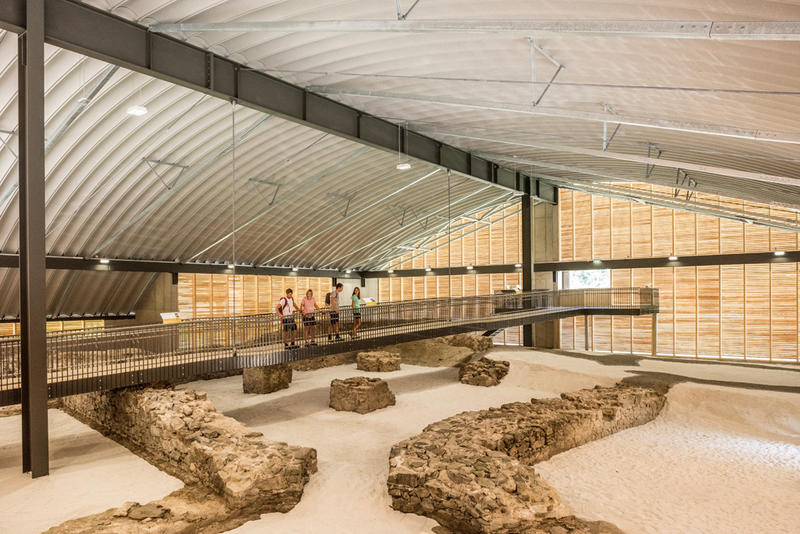
Since the 1st century several construction phases have been documented, the most significant one in the 4th century when a substantial reinforcement of the fortifications led to monumental buildings, three of which are still preserved: The Fortlet, the Fan- shaped Tower and the Granary. They still are characteristic for the centre of the village. The remains of the Roman Sanctuary are kept under the parish church.
#Roman museum
in
#Tulln an der Donau
at
#
Marc-Aurel-Park 1 B
#
The Roman Museum exhibits a host of original finds to describe military and civilian life in Comagena, the Roman cavalry fort in Tulln.
#Roman burial ground
in
#Zwentendorf an der Donau
on
#
Baerndorf
#
Near Zwentendorf was from 1 to the 5th century a.d. a Roman fort (Asturis). It was a part from Limes Norici of the Roman province Noricum.
#Wachau Cultural Landscape
from
#Krems to Melk
#
The development of the settlements with their homogeneous character becomes evident in the town structures, both in the fabric and arrangement of the houses on mostly irregular lots and in the street patterns, which have remained practically unchanged since the late Middle Ages.
#Roman buildings
in
#Mautern an der Donau
at
#Venusberger Str. 10 + Kirchenpl. + Hauptpl. 1 + Gartenring 12-20 + Wiener. Str. 17
#
A museum dedicated to the Roman Empire times, when Castell Faviani was in place of today's town centre. Also a part of the Roman wall (Römerwand) can be found here.
#Roman watchtower
in
#Rossatzbach
at
route 33, Windstallgraben
#
The square tower measured about 9 × 9 m, covered an area of around 12.4 m² and was built over an older, smaller predecessor building from the 2nd to 3rd centuries AD.
#Roman watchtower
in
#St. Lorenz
at
St. Lorenz 4
#
The church is one of the smallest churches in the Wachau and was built as a place of worship for river boatmen. The remains of a late antique burgus are built into the northern tower-like building. The north wall of the nave forms the older south wall of the rectory and thus at the same time that of the Burgus. A section of it can still be seen on the west side between the roof and the church.
#Roman watchtower
in
#Bacharnsdorf
at
#Bacharnsdorf 7
#
Presumably it was built around 370 AD by soldiers of the milites auxiliares Lauriacenses as part of Valentinans I's border security measures . The tower was used until the high Middle Ages.
#Roman Horseshoe Tower West
in
#Poechlarn
at
#Regensburgerstraße 14a
#
The auxiliary troop and cavalry camp belonging to the Noric Limes was built near the confluence of the Erlauf into the Danube and was probably continuously occupied by Roman soldiers from the 1st to the 5th century AD.
#Roman watchtower
in
#Ybbs an der Donau
at
Donaulaende 7
#
In ancient times, this section of the Danube was difficult to pass due to whirlpools and rapids, which is why the station may have served as a safe anchorage for shipping or as a base for the Danube fleet . The tower there (or possibly also a small fort) was possibly used to monitor the mouth of the Ybbs.
#Duerrenstein Forest
in
#Ybbssteinbach
at
#N47 46 30 E15 3 43.2
#
The 3500 ha Wilderness Reserve Duerrenstein hosts the remarkable Rothwald virgin forest, the biggest remain of untouched woodland in the Alps and in Central Europe. Rothwald is a strict reserve (IUCN category I) and is closed for visitors. But there are some marked trails in the rest of the reserve and the protected area's management offers guided tours into the wilderness around Mount Duerrenstein.
#Castle
in
#Wallsee
at
#Marktplatz 2
#
Like many other medieval castles the first castle of Wallsee was built in the place of a former Roman camp.
#Roman Fort St. Pantaleon-Stein
in
#Albing
at
Ringstrasse 9
#
Archaeological digs, particularly geophysical surveys, have revealed a planned settlement layout with workshops and early road networks, highlighting its importance as a supply base and early military presence in the region.
#Oberoesterreich state [capital = Linz]
#Cultural Landscape
from
#Hoher Dachstein (Hallstadt)
to
Salzkammergut
#
Systematic salt production was being carried out in the region as early as the Middle Bronze Age, (the late 2nd millennium BC), when natural brine was captured in vessels and evaporated. Underground mining for salt began at the end of the late Bronze Age and resumed in the 8th century BC when archaeological evidence shows a flourishing, stratified and highly organised Iron Age society with wide trade links across Europe and now known as the Hallstatt Culture. Salt mining continued in Roman times and was then revived in the 14th century.
#Prehistoric Pile Dwellings
in
#Mondsee
at
#
Marschall-Wrede-Platz 1
#
The presentation of the UNESCO World Heritage Site is designed to answer the most frequent questions about the up to 6000-year-old sunken villages.
#Prehistoric Pile Dwellings
in
#Attersee lake
#Litzlberg Süd, Abtsdorf 1/3
#
The three pavilions show different perspectives which complement one another and make you want to visit all three sites.
#Nationalpark Kalkalpen
in
#Bodinggraben + Hintergebirge + Reichraming
#
Kalkalpen National Park has visitors centers in Molln, Ennstal, and at the Hengstpasshuett near Rosenau. The Wurbauerkogel, a 21 metres (69 ft) high panorama view tower, is located near Windischgarsten. It is accessible by a chair lift and hiking paths. In clear weather 21 peaks of 2,000 metres (6,600 ft) or greater in elevation can be seen from Wurbauerkogel. The park has numerous hiking, mountain biking, and horseback riding trails. The former Steyr Valley Railway, with sections now the Steyrtal rail trail, pass through the park in the Molln area. In the winter there are snowshoe hiking and alpine skiing routes.
#Roman museum
in
#Enns
at
#Hauptpl. 19
#
Lauriacum / Enns was one of the largest and most important trading and military bases on the northern border of the Roman Empire.
#Schlossmuseum
in
#Linz
at
#
Schlossberg 1
#
Linzer Schloss is an eye-catcher in Linz's historical Old Town, which is situated only a few hundred metres from the Danube.
#Roman watchtower
in
#Wilhering
on
#
Eferdinger Str.
#
Various Roman sculptures show you the way and take you to the exhibition site with the Roman baths and Roman fort/Roman gate and, of course, up to the Schlögen Danube view.
#Roman castle Schloegen
in
#Haibach ob der Donau
on
route 130
#
The small fort was located on a ten to eleven meter high terrace between the Andlersbach and Muehlbach, to the west of which the associated vicus on an approximately 17 m high plateau.
#Roemerburgus Oberranna
in
#Engelhartszell
at
#Oberranna 5
#
This important border post at the Danube Limes is approximately 1700 years old and the best preserved antique building in Upper Austria.
#Salzburg state [capital = Salzburg]
#Historic Centre
of
#Salzburg
see
#detail
#
The Salzburg skyline, against a backdrop of mountains, is characterized by its profusion of spires and domes, dominated by the fortress of HohenSalzburg. It contains a number of buildings, both secular and ecclesiastical, of very high quality from periods ranging from the late Middle Ages to the 20th Century.
#Steiermark state [capital = Graz]
#Historic Centre
of
#Graz
see
#detail
#
The highlights of bygone Graz include the impressive Italian Renaissance arcades of the Landhaus Courtyard (where today the Styrian regional parliament meets), the stonemasonry masterpiece that is the dizzying double spiral staircase at the entrance to the Burg, and the cluster of magnificent buildings that are the Cathedral and Mausoleum commissioned by Kaiser Ferdinand III and Kaiser Ferdinand II in Italian style.
#Eggenberg Palace
in
#Graz
at
#Eggenberger Allee 90
#
Eggenberg Palace (German: Schloss Eggenberg) in Graz is the most significant Baroque palace complex in Styria. With its preserved accouterments, the extensive scenic gardens as well as some additional collections from the Universalmuseum Joanneum housed in the palace and park, Schloss Eggenberg counts among the most valuable cultural assets of Austria.
#Semmering Railway
in
#Muerzzuschlag
at
#Bahnhof
#
The property Semmering Railway begins at Gloggnitz station, at an altitude of 436 m, reaches its highest point after 29 km over the pass at 895 m above sea level, and ends 12 km further away at the Muerzzuschlag station, 677 m above sea level. In total, the fourteen tunnels are 1,477 m long, nearly one-tenth of the entire line; coincidentally, the sixteen major viaducts also total 1,477 m in length.
#Vienna state [capital = Vienna]
#City
of
#Vienna
see
#detail
#
The historic centre of Vienna is rich in architectural ensembles, including Baroque castles and gardens, as well as the late-19th-century Ringstrasse lined with grand buildings, monuments and parks.
#Palace
in
#Schoenbrunn
at
#Schoenbrunner Schlossstrasse 47
#
The site of the Palace and Gardens of Schoenbrunn is outstanding as one of the most impressive and well preserved Baroque ensembles of its kind in Europe.
#Spa Town
in
#Baden bei Wien
at
#Kurpark
#
The focus of its main square is the Trinity Column plague memorial. Narrow surrounding streets are known for their 19th-century Biedermeier architecture. The leafy Kurpark features the Casino Baden, memorials to composers like Beethoven and Mozart, and trails leading to Kalvarienberg, a hill where the park transitions into the Vienna Woods.